Voices — European Festival of Journalism
About
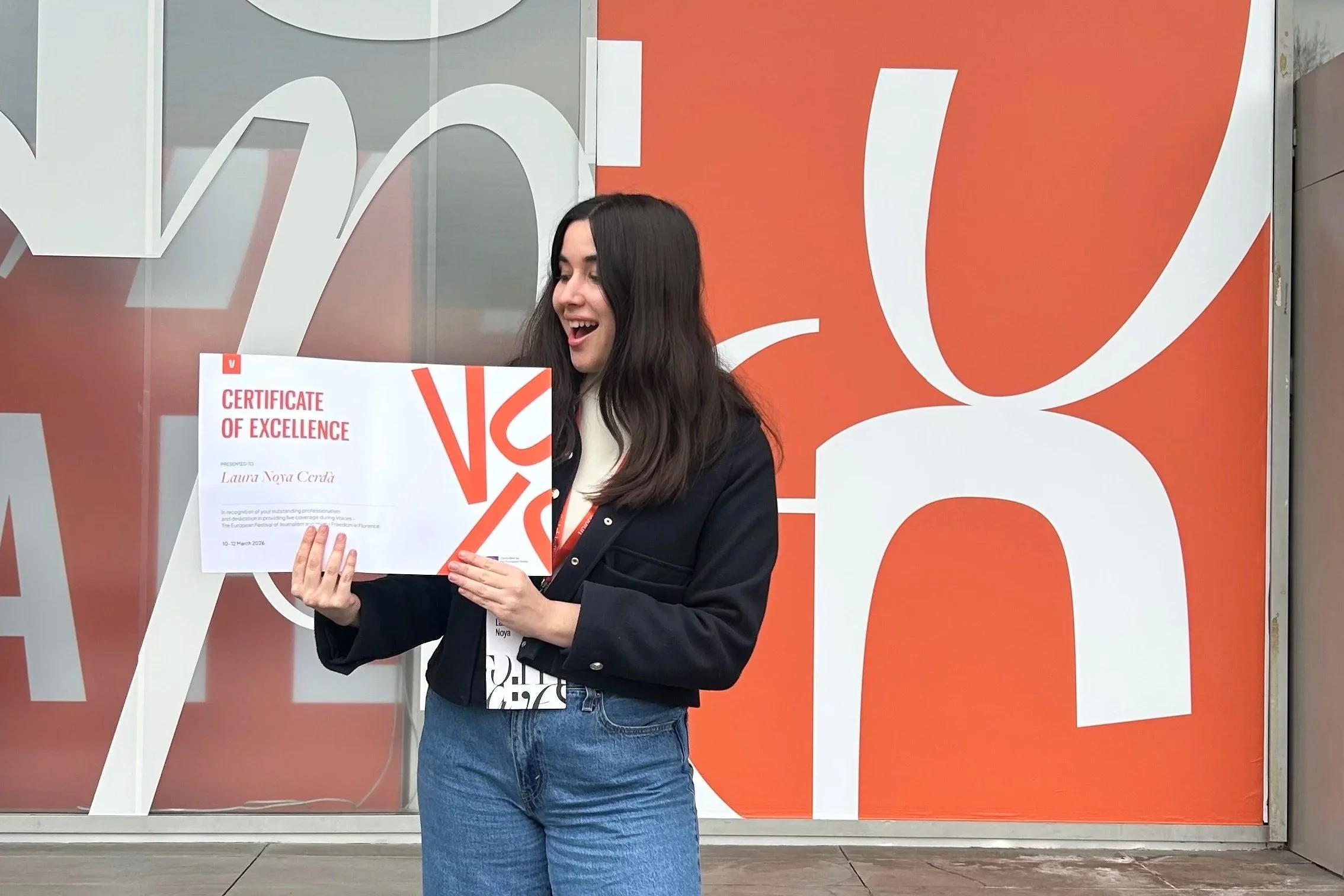
Selected for the Students' Newsroom at Voices, the EU-funded European Festival of Journalism, I spent three days in Florence reporting the festival's sessions alongside forty students from five journalism schools.
-
Voices is the European Festival of Journalism and Media Freedom, held in March 2026 at the Teatro del Maggio Musicale Fiorentino in Florence and funded by the European Union. Its Students' Newsroom brought together more than forty students from five journalism schools across Spain, Italy and Croatia to report the festival live — a working newsroom run as a laboratory for the future of European journalism.
-
Over three days, 10–12 March, I worked in the Students' Newsroom, reporting sessions and producing content for the festival's social channels and website. I covered debates on trust in democratic institutions and on the European Media Freedom Act; workshops on building audience trust and on the "foreign agent" label used to discredit journalists; documentary screenings on AI and disinformation; and the closing "Voices for Justice" press conference with figures including Matthew Caruana Galizia, Renate Schröder and Antoine Bernard. Each session had to become clear, accurate coverage on a deadline, produced within an international team.
-
This was journalism done, not just discussed — and the subject matter was the hardest end of the profession: press freedom, the safety of reporters, disinformation, and the pressure authoritarian states place on the press. Covering a panel on protecting women journalists, or a workshop run by a reporter who has been branded a foreign agent, means understanding the stakes well enough to report them faithfully and fast. Doing it inside a newsroom split across three countries added the real-world layer: agreeing tone and framing across languages and journalistic cultures.
-
Three days in a live, international newsroom showed me how collaborative journalism works across borders, and how to turn dense, high-stakes material into coverage a general audience can follow — quickly, accurately, and in a second language. It's the experience that most directly connects my International Relations background to communications: taking a complex subject with real political weight and making it legible to people who weren't in the room.
Covering the festival, day by day
Day 1
The festival opened with a welcome from Giovanni Melogli, Armando Barucco and Iva Nenadic on the values that shape journalism. I covered two debate sessions: one, moderated by Pier Luigi Parcu, on trust in democratic institutions in uncertain times, with William Drozdiak, Erik Jones and Renate Schröder; and a second on the impact of the European Media Freedom Act on Italy's national media, moderated by Francesca De Benedetti with Barbara Floridia and Elisa Giomi.
Day 2
Day two moved from debate to practice. I took part in Francesca Festa's workshop on building trust with an audience and shaping a media persona, and covered the screening of The Truth Effect, a short documentary on AI and disinformation. A panel with Marie Palmer and Dušan Velimirović addressed the protection of women journalists — harassment, mentorship and solidarity. The day closed with Bloodline, an award-winning short on the Poland–Belarus border told, unusually, through the eyes of a bison.
Day 3
The final day centred on press freedom. The "Voices for Justice" press conference brought together some of the most significant figures in journalism today — Matthew Caruana Galizia, Jamie Wiseman, Tom Gibson, Flutura Kusari, Renate Schröder and Antoine Bernard — on the need for a safe space for reporters and the many forms of aggression they face. Elena Rodina's workshop, "Are you a foreign agent?", examined how authoritarian governments use the label to discredit journalists, and Vicky Hristova moderated a debate on minorities and diversity in public service media.