Cabaret at the Kit Kat Club
A journey to the past… and the present
Context
Cabaret was the first show I saw during my semester abroad in New York City. I had been in the city for nine days, which seemed like too long without having already seen my first musical. The first day I got off from classes and other plans, I got my rush ticket as soon as I could. I didn’t see Cabaret once but twice, as my university offered a special sale of selected shows and events so students could get tickets with a reduced price. Of course I was present for every single one of them, including Cabaret, not caring at all if I had already seen it.
Before the show
I got recommended this production by one of the guest stars from El Camerino, my musical theatre podcast, who had seen the show in the West End and really encouraged me to see it. The show reimagines “Cabaret” with an immersive 360º stage and even a prologue in the theater's hall. Even its name has been changed, adding the concept “at the Kit Kat Club” to make sure the audience feels like guests in a clandestine night club in 1929 Berlin. Staff make sure to cover all phone cameras with a sticker to prevent illegal recording and preserve the experience's mystique. Still, Broadway.com made a special video showing how the August Wilson Theatre was reformed exclusively for this production. The new August Wilson features a 360º circular stage, with two stalls and two balconies. Around the stage, there are the mythic cabaret tables with phones, which include a special welcome menu.
What is “Cabaret”?
In the last days of the Weimar Republic, the Kit Kat Club opens its doors each night to leave your problems outside and see how beautiful life is at the cabaret. Cliff Bradshaw, a young American writer looking for inspiration for his new book, can’t resist to get carried away by the revelry of this club led by the Emcee and featuring Sally Bowles as its main star. Cliff finds a home in Frau Schneider’s inn, where also lives the Jewish fruiterer, Herr Schultz, and Fraulein Kost, a prostitute. Through Cliff’s eyes, we will see how Berlin falls into nazism and how each character has to face the reality they are trying to escpae. Some of them try to ignore it, deny it, or even comform themselves with accepting it if that makes them live one day more.
A crudely reimagined cabaret
It’s a crude and visceral show: while it tries to cover society’s flaws with spectacular numbers, the main colors that prime the stage are neutral, cold tones. During the two and a half hours, there is a constant tension, as if something might explode at any minute. The contrast between the two acts shows the two faces of Germany knocking out the door nazism. The first act is all color, celebration, satire, and love. Talking about love, there is the pure love that grows between Herr Schultz and Frau Schneider, two older people who give each other a chance, regardless of their age or ethnicity. There’s also a more rushed love between Cliff and Sally. But love takes many other forms in Cabaret, such as the Emcee’s love for art, or at least that’s what he transmits. He’s a character who loves the audience and wants them to have a good time despite what’s happening outside the cabaret doors. Sally also practices self-love. Despite loving her life as the star of the Kit Kat Club, she knows when to say “bye bye mein herr” to her abusive manager, and in her first ten minutes on stage. I believe she evolves so quickly because she had to grow up too fast. Although we know her as a brat who skipped school to sing at a club, she shows us that she is a woman who knows what she wants despite her youth.
The second act is a slap in the face. As the first act is so intense and joyful, the twists in the second one are a total shock: a dance that turns into a military march, a shattered glass in Herr Schultz’s shop, or a joke comparing Jewish people with monkeys. You realize it when it’s too late. The second act has fewer songs and more talked-through scenes. Berlin, which is already a character more, falls into the shadow of nazism, as well as the main characters. Cliff, who had come to get inspired, sees that the only way now is to go back to America. He loves Sally and invites her to join him, but she sees that her destiny is already sealed: she is an artist, and her world is the cabaret; there is no other way. She already warned us in the first act: “You’ll never turn the vinegar to jam.” She will never change to please somebody else. In this specific production, she sings the title song, her final statement, wearing Cliff’s suit, showing how she is the master of her own destiny, regardless of how tragically her story will end.
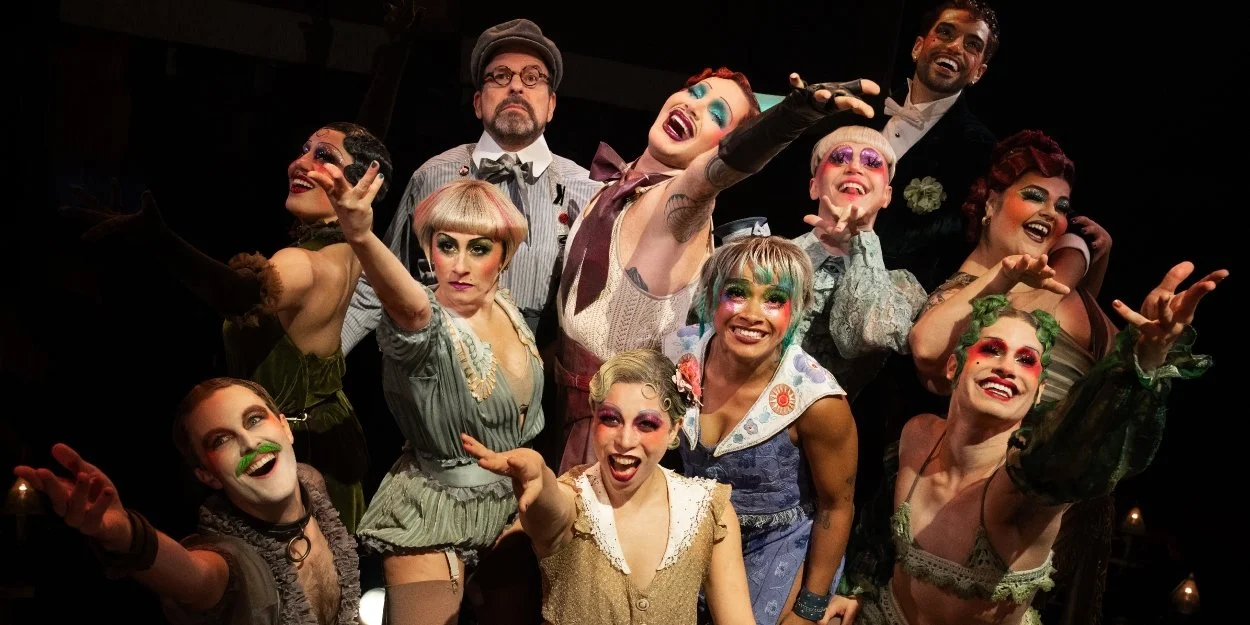
“Willkommen”: The Emcee welcomes the audience to sit and have fun at the Kit Kat Club.
The Emcee: Angel or Demon?
The two times I saw the show on Broadway, I had the opportunity to enjoy different casts. In fact, my first time was with the understudies for the main characters. The Emcee, usually played by American Idol alum Adam Lambert, was covered by Marty Launter, also known as Marcia Marcia Marcia in RuPaul’s Drag Race. This character has always been analyzed through different approaches, but this production gives him a unique twist, and even more when you see two actors playing him. The Emcee starts out dressed as a party guest, wearing a cone-shaped hat that, depending on how you look at it, sometimes resembles a demon horn.
From “Money Money” to the end of Act 1, the Emcee is disguised as a dark skeleton, with pearls as bones, a cinema noir-inspired makeup, and a German soldier's helmet. There are people who say that the Emcee is the personification of Berlin. During the last days of the Weimar Republic, poverty and hunger were on the streets, with tensions rising day by day. The Emcee is a hungry skeleton getting ready to fight while he sings how money makes the world move around. And for money, you do anything, like Cliff, who joins Ernest Ludwig in bootlegging. It’s a shock for both the characters and audience when we discover that Ludwig is openly nazi, and how he shifts from a friendly personality to a harsh coldness when the political situation changes. Ludwig teaches us how easily extremism can enter into our lives: as a friend who promises help in exchange of support, and without looking threatening at all.
Almost at the end of the show, during “I Don’t Care Much”, I thought that the production made a change by making Ludwig sing that Emcee song, as a man wearing a suit appeared on stage. The only difference was that he had blonde hair, so my first thought was that Ludwig had changed it to match the aryan race profile better now that the nazis had taken over Berlin. But when the actor turned around, I realized it was actually the Emcee! The same one I had seen, full of makeup and color, was now giving Sally a hard look, breaking down. While I perceived Marty’s Emcee as more impassive, accepting the new shift the Kit Kat Club was making to please the government, Adam Lambert’s was more affected, trying to hold back his tears. His Emcee was obviously following a script, and was trying to hide his discomfort with the antisemitic jokes he had to do as the host of the club. Even his movements are less graceful, more like a puppet's.
Enjoy Adam Lambert’s rendition of “I Don’t Care Much”.
An ending that watches us
One of the highlights of this production is the unique twist at the end. Most “Cabaret” productions tease scenes in which the main characters end up in concentration camps due to their circumstances. I would say it’s the most obvious choice, and yet the most realistic, given the show's historical and social context. But theatre allows us to play with all the possibilities, and even break out of conventions. Throughout the show, the colors and shapes have been diluted until everyone is seen wearing the same beige suit, hairstyle, and no makeup, all looking in the same direction. Some people have said that it’s too simple an ending, lacking realism: in which world would these characters survive during the Third Reich? Well, for the same reason as the Emcee, and therefore, Berlin: submitting to power. As the Willkommen theme gets reprised, now with more dissonant harmonies, the Emcee takes the baton and directs all of those who are under his control, or at least, who control the Emcee and Berlin. This ending seems to focus more on what Germany was during nazism, but also a hint of what is happening nowadays with the rise of far-right movements and how minorities can be in danger. A line that I still think about from the show comes from Sally: “Politics? And what does it have to do with us?” The answer is: everything. There is too much at stake to just look away from the problems and assume that progress can’t go back.
I still remember the whisperings from the audience when the show ended, how people felt that what they had seen was too real for a Broadway musical. You have to just take a look at the news to see that Cabaret, now more than ever, continues to be present in our minds. I don’t think it’s a coincidence that the logo for this production, which can be seen everywhere from the Playbill to the theatre walls and even props, is an eye that makes us think of Big Brother’s 1984. It watches and follows us, reminding us that there is always someone (or something) on the sidelines who could turn the tables on our destiny.
Recommendations
Although the show closed on Broadway, you can still enjoy the same one in London. In fact, it is the original one, as it opened first in the West End with Eddie Redmayne and Jessie Buckley. It still features many iconic duos of performers to play Sally and the Emcee. If you are in London and want to see a show that doesn’t fall into stereotypical Broadway “razzle-dazzle”, Cabaret might be a unique experience for you. Also, if you are a fan of history and politics, especially Second World War-inspired stories, its immersive stage will take you there without disconnecting you from reality. And mostly, if you like over-analyzing and taking out different takes on the same story, this is your show! You can find your tickets in the official page.
